
A closer look at what's inside Bouquin & Ink — how each piece was built, what it does on the page, and what it deliberately doesn't.
Long-form manuscript editing with three immersive desk themes, binder navigation, and grammar checks that respect your voice.
Read more → IITracks structure, vocabulary, and rhythm against your own baseline. Flags drift before it becomes rewrites.
Read more → IIIWorld bible cross-referenced live. The pendant was silver in chapter one — we'll mention if it changes.
Read more → IVMood-driven prompts, timed sprints, ambient audio, fragment journal. The door into the scene.
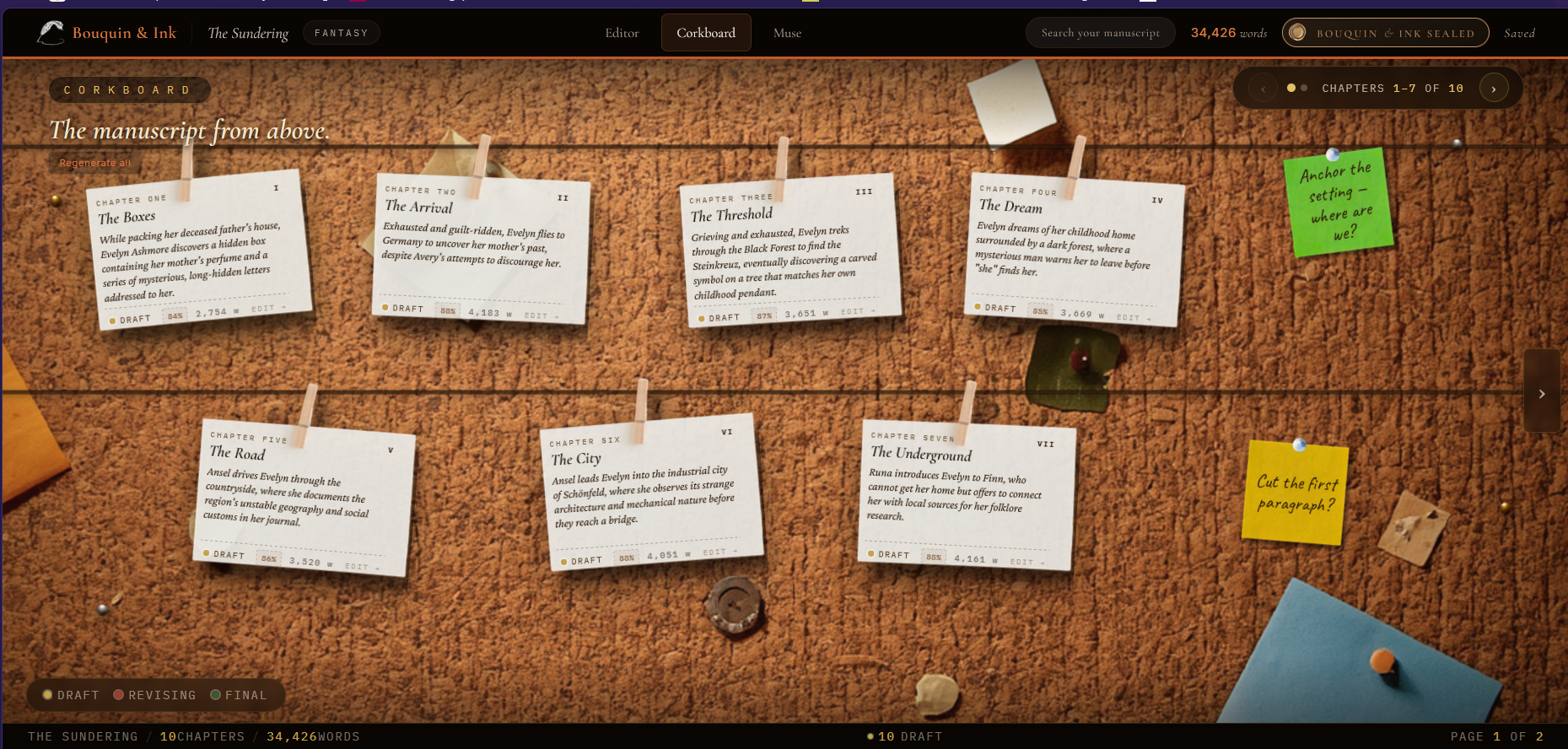
Read more → VIndex cards for every chapter — synopsis, word count, voice match, status. The book from above.
Read more → VIExport to industry formats. Query letter builder. Submission tracker. Your provenance seal travels with you.
Read more →
A long-form editor that gets out of the way. No rails, no rewrites, no AI ghostwriter sitting in the margin.
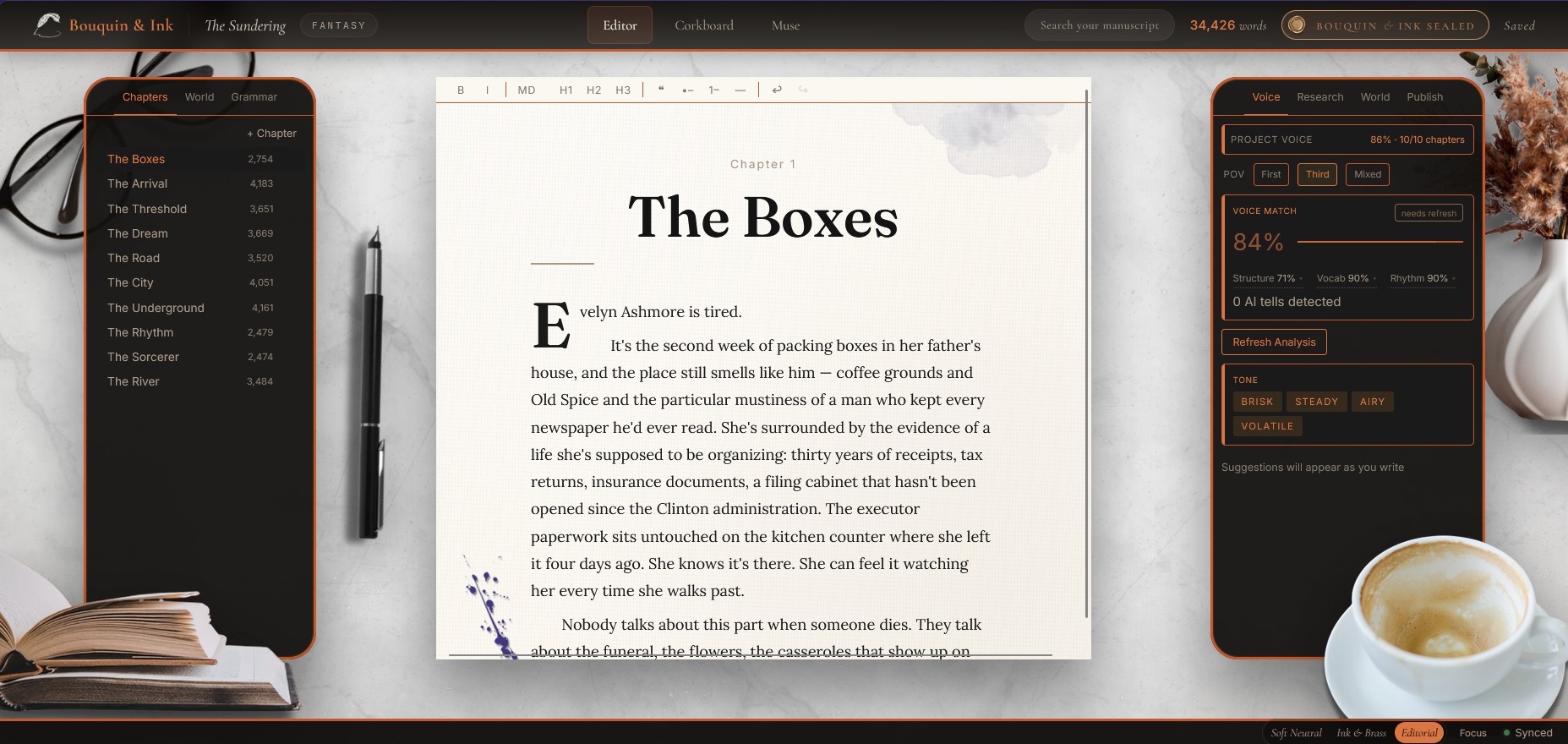
Soft Neutral, Ink & Brass, Editorial. Each one a different mood. Switch any time, even mid-sentence.
Parts, chapters, scenes — drag to reorder, fold what you're not working on, every level keeps its own word count.
Catches typos, agreement errors, and punctuation. Doesn't suggest you "tighten" your prose. Sentence fragments stay where you put them.
Saves on every keystroke. Browse any version of any chapter back to your first draft. Restore in one click.
Voiceprint doesn't grade your writing. It maps your structure, vocabulary, and rhythm against a baseline built from your own strongest prose — and shows you where today's draft drifts.
Drop in 10k+ words of your strongest existing prose. Voiceprint builds a fingerprint specific to your writing — not a corpus of literary fiction.
Every metric is plotted against your own patterns. A flagged passage is information — you decide if the chapter calls for it.
If a passage reads like it was generated, Voiceprint flags it. Not to accuse — to let you catch the seams before anyone else does.
Continuity extracts facts from every chapter and cross-references them against your world bible. Timeline conflicts, object inconsistencies, location changes — surfaced before they become plot holes.
Catches when your character's mother died twenty-eight years ago in chapter three but four years ago in chapter seven.
The pendant was silver with grooves in the prologue. If it becomes gold in act two, you'll know before your editor does.
Your character is packing a house in Boston. Three chapters later they're clearing it. Continuity asks which one it is.
Every flag links back to the specific chapters where the conflict exists. Click through, see the context, decide if it's intentional.
For the days when the page is blank and the cursor is blinking. Muse Board doesn't write for you — it sets the table so you can sit down and begin.
Devotion, dread, longing, silence, awe — and seven others. Each draws from a curated library, plus prompts shared by the community.
15, 25, or 60-minute focus blocks. Optional ambient audio. Optional hide-the-word-count toggle. Your fingers, your pace.
The lines that don't have a home yet. Tag them, search them, drop them into a chapter the moment they fit.
Every chapter as an index card. Auto-generated synopsis, word count, voiceprint rating, and status — all visible at a glance. Drag to reorder. Click any card to jump straight to the chapter.
Export your manuscript in industry-standard formats. Build query letters. Track submissions. Your provenance seal travels with you.
DOCX (Shunn standard), PDF, EPUB, Markdown, Plain Text, and Full Bundle as .zip. Front matter, scene breaks, and headers handled automatically.
Templates by genre, fillable hook/comp/bio sections, and querying notes with current industry guidance baked in.
Agent name, agency, date sent, response status, deadline reminders. Your slush pile, organized.
The Voice Verified seal travels with your export — authorship verified by Voiceprint, saves tracked, sealed with a timestamp. Agents can verify the document came from your pen.
Yes. Voiceprint analyzes structural patterns, not subject matter. Memoirists, essayists, and journalists use it to maintain a consistent voice across long-form non-fiction projects.
English at launch, with French in active development. Voiceprint's structural analysis is language-agnostic in principle, but each language requires its own tuning.
Yes. The editor, binder, and corkboard work fully offline. Voiceprint and Continuity require an internet connection to score and cross-reference; their results sync once you're back online.
DOCX, Markdown, plain text, and Scrivener exports all import cleanly. Chapters, scene breaks, and basic formatting are preserved.
It does. Grammar checks defer to your established voice — sentence fragments, comma splices, and other "errors" that are part of your style are recognized and left alone.
Beta is free. Founding pricing locked in when we launch.
Join the Beta →