Every save, every revision, every voice match — logged from your first sentence to your last. When the manuscript is ready, the record is already there.
Not a guess. A receipt for the work you actually did.
See what's in the certificate →Every sealed manuscript carries a verification certificate. The seal is the visible mark — the certificate is the record. Anyone with the link can confirm the document is what it claims to be, without ever seeing the manuscript itself.
The seal isn't just a badge on a webpage. It embeds in your manuscript exports, your query letters, your submissions — so an agent reading your pages on their tablet at 11pm sees the same verification a publisher sees on a contract.
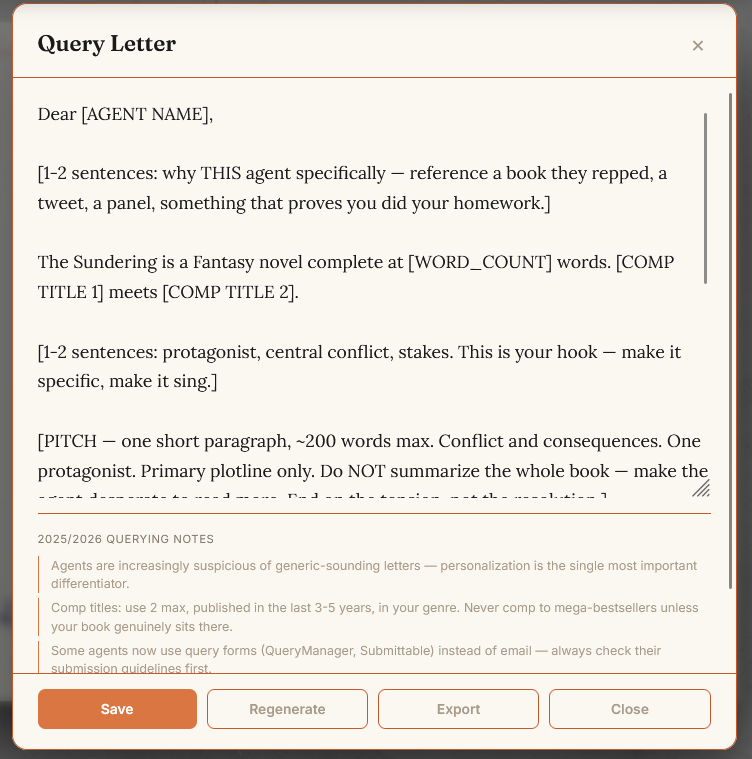
Templates by genre, fillable hook/comp/bio sections, and current 2025/2026 querying notes baked in. The seal sits in the footer of every letter you send.
DOCX (Shunn standard), PDF, EPUB, Markdown. The certificate embeds in document metadata — invisible until verified, undeniable when checked.
Agent name, agency, date sent, response status. Your slush pile, organized — with the seal traveling alongside every submission.
Every time you write in Bouquin & Ink, the system documents your process. Not what you write — how the manuscript evolves. A human writing process looks fundamentally different from a pasted-in generation, and the record shows it.
How your manuscript grew from the first sentence forward. Saves tracked, revision history preserved, deletions logged. The shape of a real draft — false starts, restructures, sentences that lived for ten minutes — is part of the record.
Voiceprint scores your chapters against your natural patterns. A manuscript written by one person shows a consistent signature across months of work. That consistency — captured chapter by chapter, save by save — is what the certificate ultimately attests to.
When you're ready, Bouquin & Ink seals your manuscript. The certificate is generated, the document ID is locked, and the badge is yours to display. The record stays with the manuscript wherever it goes.
Voiceprint scores your writing — but it scores it against you, not against a generic profile of "what AI sounds like." Your fingerprint is built from your own strongest prose. A flagged passage means it drifted from your patterns, not that it failed a global test.
You also tell the system what's intentional. The Voice Allowlist lets you flag em dashes, abstract metaphors, signpost words, or any pattern as part of your voice — so they don't get flagged unintentionally. POV gets the same treatment: first, third, or mixed, recognized and respected.
Generic detection guesses at humans. Voiceprint measures the one you actually are.
Provenance is included free with the beta and on every paid plan after launch.
Join the Beta →